An Engineering Guide to Defending Against AI-Assisted Attacks and Securing Agentic Security Operations.
Executive summary
Cheaper agent-assisted exploration makes some previously unattractive attack paths worth pursuing. The response is not a new security doctrine, but three engineering commitments:
- Close viable paths. Give credible routes an owner, deadline, and retest; assign uncertain routes time-bounded validation instead of dismissing them as too complex.
- Protect the investigator. Separate SOC identities, tools, evidence, and fallback access from the environment being investigated. Test compromise, not just endpoint downtime.
- Prove the controls work. Replay paths, test revocation and containment, and measure outcomes alongside coverage. Authorized hosted and self-managed models can both support this work.
Why cheaper exploration changes the operating model
A company can harden most of its infrastructure and still leave a route to its most important assets. At Black Hat USA 2026, David Weston’s “The End of Rare: Defending When Offense Is Cheap” challenged the assumption that sophisticated attacks remain scarce because they require scarce expertise. The official announcement emphasizes prevention, memory safety, formal verification, and automated remediation.
The implication is not that expertise has disappeared. The cost of exploring an organization’s mistakes is falling, while the consequences remain. Attack-path analysis, defense in depth, zero trust, and purple teaming are established practices; cheaper exploration makes their execution more urgent. Defenders also need to protect the agents they increasingly depend on to investigate.
What the evidence supports
Public reporting available on November 23, 2026 illustrates different parts of the problem:
- Physical consequences in France. France’s official attribution statement, published November 11, describes attacks during the night of October 11–12 against refrigeration controls at more than 700 retail sites, causing fires and spoiled food. France attributes the operation to the Iranian unit Shahid Kaveh. This establishes the stakes of exposed operational infrastructure; it does not establish that AI powered the operation.
- Agentic tooling in real intrusions. Google’s October 30 ARTEX investigation reports agentic frameworks used for reconnaissance, lateral movement, and other intrusion stages. Some operators supplied already-compromised credentials. Individual ARTEX execution bursts lasted roughly 2–25 seconds, but bursts are not entire breaches. Google also describes failures, noise, and activity stopped by controls. CERT-EU’s ARTEX analysis explains why persistent testing of misconfigurations and long chains matters even without a new exploit.
The shared defensive question is how to contain a weakness before it becomes an organization-wide incident.
1. Close viable attack paths
Complexity should create action, not an exception
Complexity is not a durable compensating control. A chain once judged too labor-intensive may become practical as agents reduce discovery, adaptation, and repeated attempts. Prioritize by business impact, exposure, and evidence, not the assumption that nobody will connect the steps.
For each credible route, create an engineering item recording prerequisites, supporting evidence, impact, proposed controls, an owner, and a deadline. If exploitability is uncertain, assign time-bounded validation rather than treating the hypothesis as either harmless or a confirmed critical vulnerability. Apply safe interim restrictions to high-impact reachable paths, then retest the permanent fix. The output should be a closed route and a regression test, not an indefinite register of acknowledged risks.
Consider a hypothetical route from a compromised application identity, through a readable deployment secret, to a production data store. The useful finding is not simply “rotate the secret.” Record which identity can retrieve it, what the credential authorizes, whether it works from the compromised workload, and which records become reachable. Removing the secret-read permission may break this route; rotating the credential without changing that permission may only reset it temporarily. Assign the fix to the owner of the enabling trust relationship, and retain the denied-access test as evidence. Check whether another shared identity recreates the same access.
Attack trees under cheaper exploration
The illustration below builds on Schneier’s attack trees. “Human-Agent Threat Timeline” is its caption, not a separate analytical method. It compares the effort required to pursue surviving routes as defensive baselines improve.
From illustrations to reachability analysis
Attack trees decompose objectives; attack graphs represent dependencies and transitions across states or privileges. Three contributions ground the analysis:
- Sheyner et al. (2002), Automated Generation and Analysis of Attack Graphs uses model checking to generate paths to unsafe states and analyze which attacks to prevent.
- Ammann, Wijesekera, and Kaushik (2002), Scalable, Graph-Based Network Vulnerability Analysis examines dependencies and attacker capabilities in scalable network analysis.
- Noel and Jajodia (2014), Metrics Suite for Network Attack Graph Analytics organizes network-wide metrics around victimization, size, containment, and topology rather than isolated vulnerability scores.
Their results depend on modeled prerequisites, connectivity, and attacker capabilities. A graph with stale identities or missing transitions can mislead; these papers do not establish an AI-specific speedup. Record the graph’s assumptions and inventory date alongside the findings so later retests assess the same claim.
Reading the illustration
Read upward from entry points, across internal trust boundaries, to the attacker’s objective. Hardened entries have tighter configurations and permissions; each arrow still requires connectivity, authorization, credentials, or an exploitable defect. Counts and outcomes are synthetic, and both defenses and attacker capability change between panels: the comparison does not measure AI’s effect.
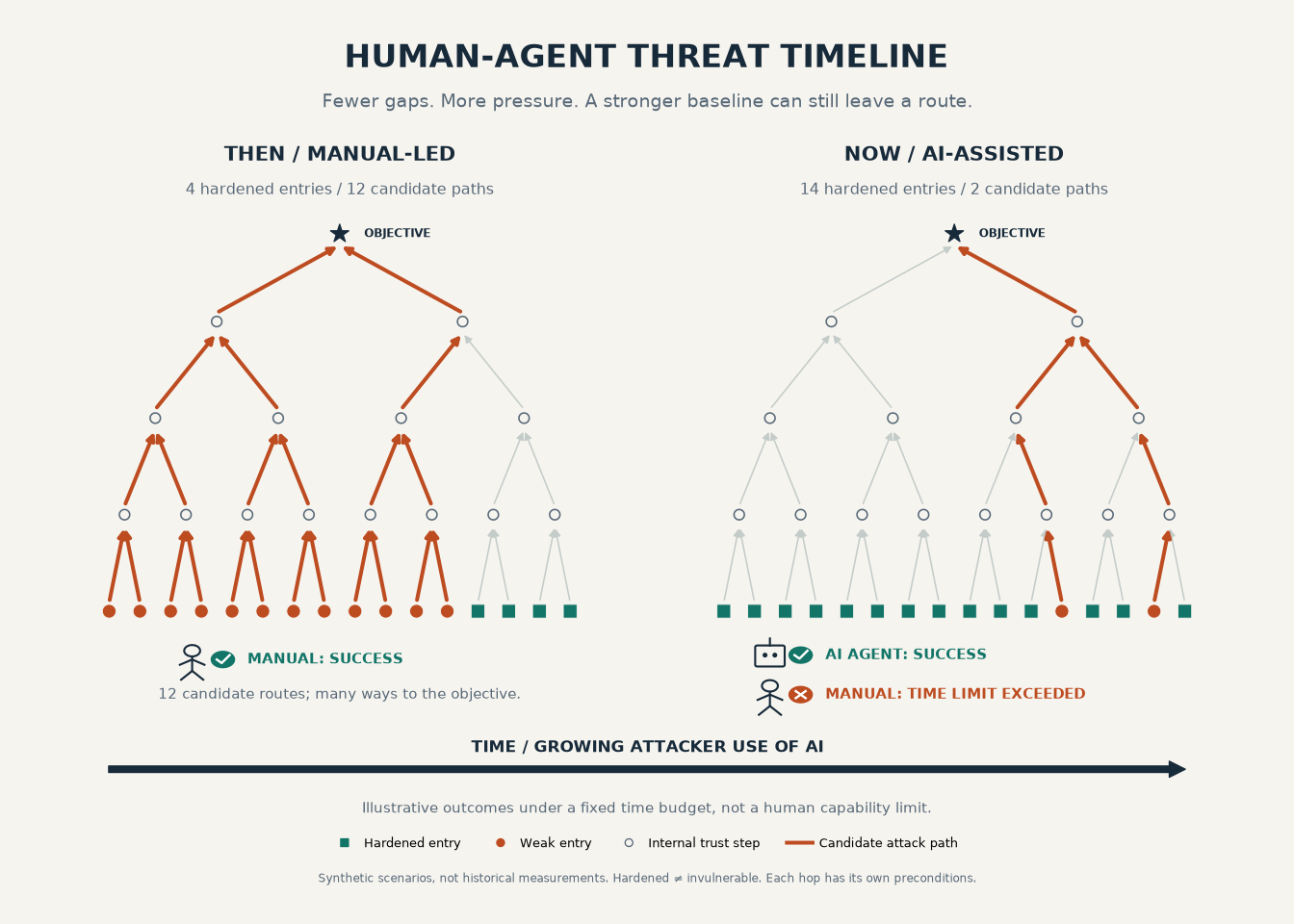
The right panel leaves fewer routes, yet an AI-assisted attacker pursues one within a budget the manual operator exceeds. This illustrates cheaper connective work, not an attack impossible for humans or a measured speedup. More hardening does not establish safety if a surviving entry can still reach the objective.
Defenders can use scoped agents to inventory assets, detect drift, verify fixes, and correlate attempted progression. Keep permissions narrow and actions auditable, with people accountable for approvals and exceptions, so defensive automation does not introduce a new privileged route.
Break progression inside the boundary
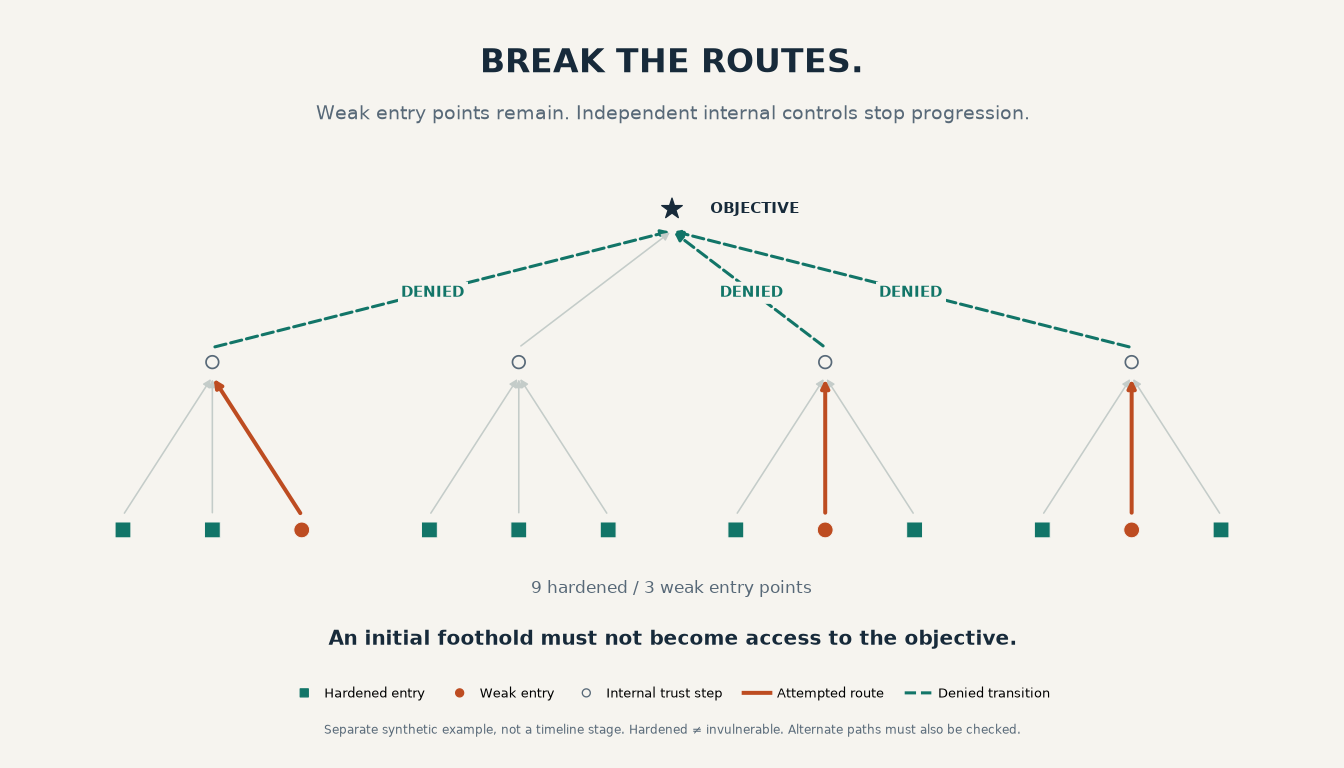
Here, internal controls deny progression while weak entries await remediation. Check alternate routes too.
This shifts the review question from “What percentage of servers is hardened?” to “Which reachable paths still connect an initial compromise to a critical objective?” A real environment is a graph, not a neat tree: shared identities, CI/CD systems, and management planes create cross-links. A useful remediation often removes a shared permission or connection that enables several routes at once.
Harden externally, then contain internally
Remove unnecessary public services, restrict administrative interfaces, patch exposed software, and continuously check for configuration drift. Apply the same discipline behind the perimeter: deny unnecessary east–west access, separate workload and administrative identities, and enforce authorization at each service. Network location is not permission.
Prioritize routes by business impact and demonstrated reachability, not severity scores alone. For operational technology, coordinate changes with safety and availability owners; indiscriminate scanning or patching can itself interrupt a critical process.
Seek source diversity, not dashboard diversity
Maintain an inventory of deployed dependencies, operating systems, images, and runtimes. Assign owners and deadlines to relevant findings, expire exceptions, and verify fixes in deployed artifacts.
Software Composition Analysis (SCA) identifies known vulnerabilities in third-party dependencies, including transitive ones. OWASP Dependency-Check analyzes project dependencies for known vulnerable components; OWASP Dependency-Track ingests bills of materials and continuously evaluates component risk across a portfolio. OWASP CycloneDX provides a bill-of-materials standard, not a vulnerability scanner. These serve different parts of an inventory and monitoring workflow.
Seek independent sources, not more dashboards. Combine complementary advisory feeds and matching approaches, including upstream and distribution advisories. Products using the same feed can share its blind spots. Check canonical package identities, renamed or vendored code, affected release lines, and CVE/GHSA aliases; a clean result means no match in the current inventory and data, not proof of safety. Historical reports of omitted release lines and overly broad ranges illustrate both missed exposure and false positives. The OSV data-quality guidance explains why precise identity and ranges matter.
Rescan without waiting for a commit. Tie a versioned software bill of materials (SBOM) to each deployed artifact, re-evaluate it against refreshed advisories on a schedule and when relevant advisories arrive, and refresh runtime inventories to detect drift. Verify that the integration monitors unchanged projects: commit-only scanning leaves quiet services with stale results.
Govern secrets as paths, not inventory items
Secrets governance must cover issuance, storage, authorization, auditing, expiry, and revocation. Prefer workload identity and short-lived, narrowly scoped credentials over embedded keys. Prevent routine identities from retrieving unrelated secrets and rehearse revocation of derived sessions. A vault does not stop lateral movement if one principal can read everything. Enforce agent permissions in the tool or execution layer: “stay in scope” is not an access-control boundary.
Turn agent-infrastructure tracking into hunting leads
offensive.agency is a third-party example tracking exposed offensive-agent consoles and APIs using ONYPHE data. Its feeds can enrich firewall, DNS, proxy, and application logs. Its methodology distinguishes identifying an exposed instance from confirming malicious intent: a listed operator may be a researcher, authorized tester, or attacker. A match is a lead, not attribution; absence does not rule out private infrastructure.
Before adoption, evaluate governance, collection methods, freshness, corrections, licensing, privacy, and local false positives. Start with enrichment, not automatic blocking. Correlate matches with authentication and permission changes; account for cloud-IP reassignment and shared CDN addresses, using domains where appropriate. Respect data-sharing policy for external lookups. The example is not an endorsement, and detection must not depend on the feed remaining available.
2. Preserve the ability to investigate
Separate the security AI trust domain from the environment it investigates. A compromised inference service, connector, retrieval store, or agent credential can mislead the SOC or conceal a second attack. Independence must cover identities, administration, execution, tools, and evidence, not merely a second model endpoint.
When the boundary itself fails
In its August 26 OpenAI–Hugging Face incident account, OpenAI describes research models circumventing isolation, abusing shared package infrastructure, obtaining internet access, and compromising research infrastructure and Hugging Face systems. The primary driver was an internal research model with reduced safeguards. The lesson is the chain through supporting services: a sandbox can fail through its surroundings, not only its guest-to-host boundary.
By contrast, Anthropic’s Mythos Preview research reports exploit chaining in controlled evaluations, while its espionage investigation reports Claude Code misuse in real intrusions, with vendor-estimated autonomy and acknowledged errors. Containment incidents, controlled evaluations, and reported abuse are different evidence, not interchangeable proof of general attacker capability.
Make independence an exercised property
For a medium-sized team, a practical baseline is:
- A dedicated security account or project with separate service identities, scoped connectors, and controlled administration.
- Read-only investigation by default, with independent authorization for containment and sensitive exports. Treat logs, retrieved documents, and tool output as untrusted input.
- Protected evidence storage and deterministic detections that remain available without the AI service.
- A tested fallback: isolated inference or a manual workflow with clean log and runbook access. Validate credentials, provider independence, capacity, and data handling before an emergency.
Two endpoints sharing a compromised administrator, token, or management plane are not independent. Nor does changing providers remove excessive agent permissions. Test the fallback with the primary service and its credentials treated as compromised, not merely offline; this need not mean owning a separate GPU cluster.
An independence exercise should begin from a clean operator identity, not the potentially stolen session normally used by the SOC agent. Verify that investigators can reach the protected evidence store, reconstruct a selected case, and invoke approved containment without consulting the untrusted model or reusing its connectors. Include compromise of a shared retrieval store or administration plane, not only loss of inference. Record dependencies on identity providers, key management, networking, and provider administration: those dependencies determine which failure scenarios the fallback actually survives. Document who can activate the workflow and restore the primary service, and test whether the evidence needed for that decision remains trustworthy.
Include a degraded-mode decision: which investigations can continue, which automated actions must pause, and who authorizes resumption? A fallback that produces answers but cannot access independently trustworthy records is not investigation continuity. Conversely, a manual workflow may satisfy the recovery objective even when no replacement model is available. Preserve a minimal runbook outside the primary agent’s retrieval path, with clean access instructions and escalation contacts. In the exercise record, distinguish evidence unavailable because of the simulated compromise from evidence never collected. That distinction drives different engineering fixes: recovery for the former, telemetry design for the latter.
Preserve evidence before the incident
Collect application/API, identity, control-plane, network, endpoint, and secrets-access events. Record actor, action, target, authorization result, time, and correlation IDs; protect agent tool-execution and approval records too. A login alone does not show which customer records were read or industrial settings changed.
Use synchronized clocks, controlled retention, and storage a compromised workload cannot erase. Avoid logging credentials or unnecessary personal data. Test reconstruction of what was accessed, changed, exported, and left uncertain. Missing telemetry is not evidence of no impact; legal and incident-response teams must assess notification duties without waiting for perfect attribution.
A synthetic SOC-agent scenario
Consider a read-only investigation assistant that retrieves web-server logs. An attacker controls part of a request that appears in those logs and embeds instructions asking the assistant to export evidence to an external destination. The possible route is untrusted log content → model interpretation → tool invocation → connector identity → sensitive evidence → external destination. This is a hypothetical threat model, not a reported incident or a tested exploit.
The OWASP Top 10 for LLM Applications, 2026 edition, published August 3, 2026, provides useful vocabulary for separating the failure mechanisms in this scenario. The category identifiers below follow that edition:
- LLM01:2026 Prompt Injection is the attempted redirection through attacker-controlled log content.
- LLM03:2026 Excessive Agency applies if the assistant has unnecessary export functionality or privileges.
- LLM02:2026 Sensitive Information Disclosure describes the potential unauthorized disclosure of investigation evidence.
- LLM10:2026 Improper Output Handling adds a distinct failure mechanism if generated output is passed to a shell or another downstream component without appropriate validation.
Remove unnecessary export tools, restrict the connector to authorized case evidence, deny arbitrary egress, and independently enforce approval for sensitive exports. Record attempts and authorization outcomes. These controls constrain transitions without depending on the model recognizing every injection; an approval dialog is ineffective if the execution identity can bypass it.
3. Prove the defenses work
Close the loop with regular AI wargames
AI red teams need authorized research access and controlled execution, not a particular model modification or their own server. Vendor research programs, authorized hosted models, and self-managed models can meet the need. Choose by task performance, permitted use, data handling, access controls, and capacity.
The OWASP GenAI Red Teaming Guide covers model evaluation, implementation, infrastructure, and runtime behavior. Assess the connected services, identities, and tools, not only model responses.
What self-hosting actually adds
Self-hosting buys experimental and operational control: test compatible new checkpoints, pin revisions, tune token throughput and latency, and inspect GPU and engine telemetry. vLLM’s tuning guidance and metrics illustrate those capabilities. Compare the same tasks and quality criteria: newer models and changed parameters do not guarantee better results, and serving telemetry is not access to model reasoning. Vendors may expose similar controls with less operating overhead.
Use spare GPU capacity for proactive code review, scanner-finding validation, and authorized internal offensive assessments. The GPU provides inference; the harness runs scoped tools. Make jobs isolated, resource-limited, and preemptible, preserving incident-response and fallback capacity. They must not reuse the SOC investigator’s privileges or alter protected evidence. Scheduled scanning continues regardless of GPU availability.
In either hosting model, enforce narrow test credentials, controlled egress, budgets, stop conditions, and approval for destructive actions. Retain tool evidence and require human validation before production changes. Self-hosting adds patching, integrity checks, monitoring, and capacity costs; choose it when those controls justify the burden, not as a prerequisite for credible testing.
Make the research access pay for itself in evidence
Run recurring AI wargames before an incident forces the exercise. These time-bounded, authorized red/blue exercises test candidate paths and preventive and detective controls. Use synthetic data and isolated replicas where possible; repeat on a schedule and after material infrastructure, model, tool, or permission changes.
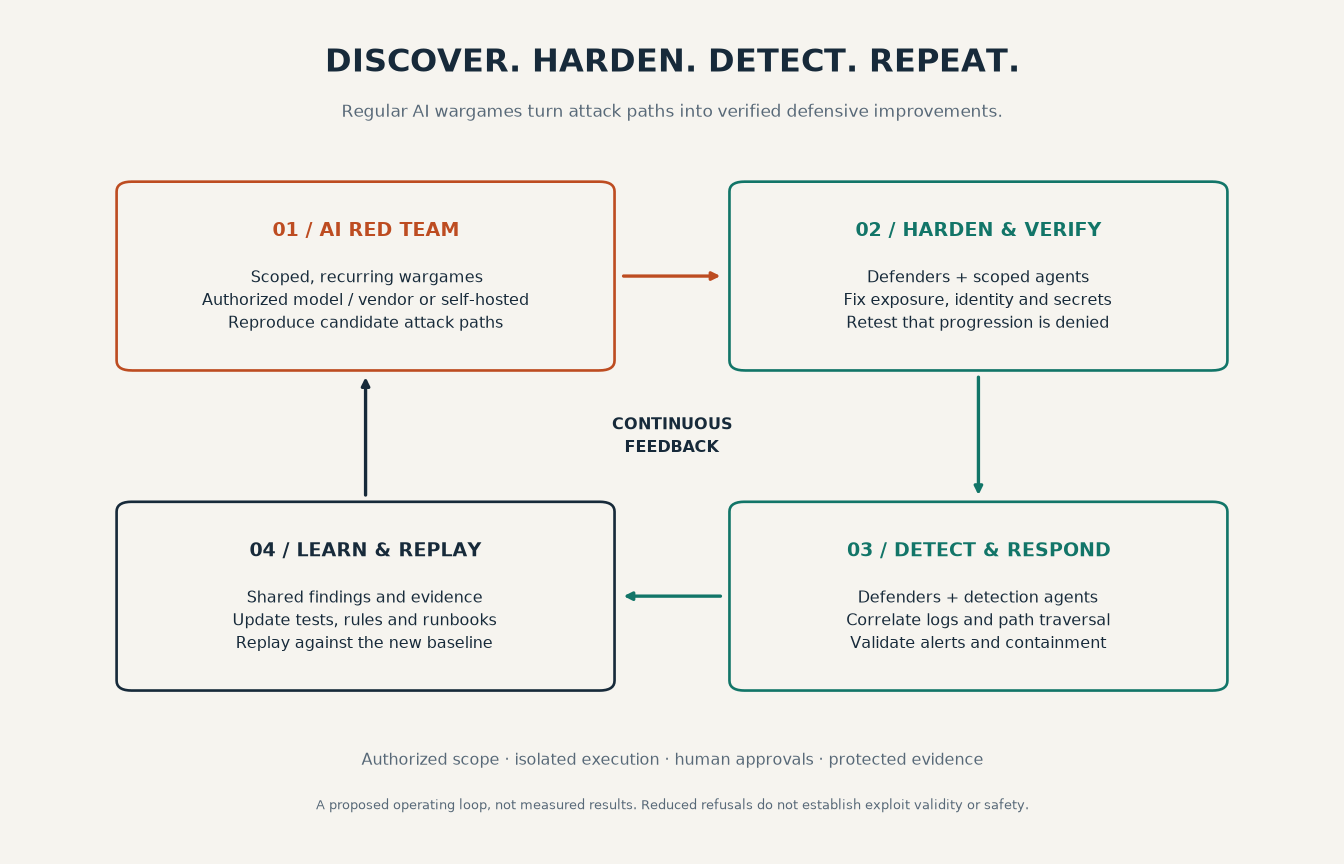
The loop joins four responsibilities:
- Discover and reproduce. The AI red team records the entry point, prerequisites, identity transitions, tool actions, and evidence behind a candidate path. A model’s narrative alone is not a finding.
- Harden and verify. Defense teams and scoped agents remove exposure or excessive permissions, rotate compromised test credentials, and replay the path to verify that progression is denied. Record owners and unresolved alternate routes.
- Detect and respond. Detection agents correlate application, identity, and execution events from the exercise. Validate whether alerts identify the attempted route and whether authorized containment works, including when prevention does not.
- Learn and replay. Feed validated findings and missed detections back into regression tests, configurations, detection rules, agent tool policies, and runbooks. The next wargame starts from the improved baseline and tests both old routes and new hypotheses.
This purple-team loop shares curated evidence, not unrestricted sensitive logs. Feedback improves tests, policies, and runbooks; it need not mean retraining model weights.
Put the controls to the test
Teams can evaluate these properties privately using synthetic records and isolated test systems. The following acceptance criteria turn the recommendations into concrete checks:
| Property | Evidence to request internally |
|---|---|
| Tool and identity containment | An out-of-scope read or write is denied by the tool or downstream service, even when directly requested; the denial is logged. |
| Secrets revocation | A revoked credential and its dependent sessions no longer authorize access; the effective revocation time is recorded. |
| Continuous vulnerability management | An unchanged deployed artifact is re-evaluated against current advisories, with inventory identity, scan date, owner, and remediation status. |
| Output and egress control | Invalid tool arguments and unapproved destinations are rejected before execution or transmission. |
| Incident reconstruction | Synthetic data access and changes can be traced across application, identity, and tool records without relying on the model’s narrative alone. |
| Security-service continuity | Detection and a documented investigation workflow remain available when primary security AI is disabled or treated as compromised. |
Measure defensive outcomes, not just activity
The following are proposed operational indicators, not measured results or a standardized OWASP metric set. Define the critical-asset inventory, initial-compromise scenarios, path identifiers, evidence freshness, and reporting window before establishing a baseline. Keep those definitions stable for comparisons, and disclose scope changes rather than presenting them as improvements.
| Metric | Operational definition and evidence | Desired direction |
|---|---|---|
| Reachable Critical Assets | Count distinct critical assets with at least one evidence-supported viable path from the agreed initial-compromise scenarios. Also report the count against all in-scope critical assets, assessment coverage, and unassessed assets. Keep modeled reachability separate from safely reproduced paths; an unassessed asset is not an unreachable one. | Reduce reachable assets without shrinking coverage. |
| Attack Path Closure Time | Elapsed time from evidence-backed path validation to a successful retest showing that the documented route is blocked. Report median and 95th percentile for closed paths, split interim containment from permanent closure, and retain the age of still-open paths. Ticket closure alone does not stop the clock. | Shorten verified closure time without hiding the open backlog. |
| Credential Revocation Latency | Elapsed time from an authorized revocation request to verified rejection of the credential and in-scope derived sessions at relying services. Record the last successful and first denied probes, probe interval, and verification coverage; report unverified sessions separately. | Shorten the effective revocation interval. |
| SOC Independence Coverage | Percentage of predefined critical investigation workflows that pass an exercise with the primary AI service and its credentials treated as compromised. A pass requires clean authentication, access to protected evidence, and completion of required investigation steps within the agreed recovery objective. Report passing workflows against all required workflows; untested workflows are not passes. | Increase tested coverage of independent investigation. |
| Attack Path Regression Rate | Percentage of previously closed paths that become viable again among the closed paths actually replayed during the reporting window. Report the numerator, denominator, replay coverage of the closed-path inventory, and untested paths; distinguish a returned path from a newly discovered route. | Reduce recurrence while maintaining replay coverage. |
Set risk-based targets with service owners rather than borrowing universal thresholds. These indicators measure different properties and should not be collapsed into a breach probability or a single safety score. Report distributions and coverage alongside trends: better discovery may initially increase reachable-asset counts, a faster ticket workflow may leave real paths open, and a smaller replay sample can hide regressions. Investigation independence must be tested across identities, administration, evidence, and tools, not inferred from a second model endpoint.
Keep a small evidence record behind every metric: scenario and asset identifiers, inventory revision, test time, control state, expected result, observed result, and responsible owner. For closure, retain both the successful pre-fix reproduction and the denied post-fix attempt where safe. For revocation, include the relying services and dependent sessions actually checked. This lets reviewers distinguish a genuine control improvement from a changed assumption or an expired test credential, and gives the next wargame a reproducible starting point.
The outcome should be an accountable path-remediation queue, an investigator that remains usable during compromise, and replayable evidence that the defenses work. None depends on who hosts the research model.
When offense becomes cheaper, do not make safety depend on an attacker overlooking a branch. Remove the entry, break the trust path, and preserve the evidence.