In my first serving post, I served an abliterated Qwen checkpoint with vLLM on a single Runpod H100 NVL. The main challenge was getting the client, chat template, and tool-call parser to work together.
The next step was a shared backend for authorized red-team users and autonomous agents. I built this proof of concept as part of my work at iFood to validate that infrastructure; the configuration described here does not reflect the company’s production environment. This post shares the decisions and trade-offs for AI Security and AI Red Teaming teams considering these models in their day-to-day authorized work.
A refusal-reduced model can help investigate behavior that a conventional assistant would decline to discuss. That makes it a useful research instrument, not a reliable judge of whether a proposed attack works.
The boundary I wanted to preserve
A dedicated project and VPC separate model serving from unrelated products and centralize access, artifact selection, and evidence retention. This is network and administrative separation, not an air gap: clients use a controlled HTTPS endpoint, and private hosts still need outbound connectivity.
The model service does not execute tools. It generates text and proposed tool calls; the agent or evaluation harness owns credentials, execution permissions, and approvals. Isolating inference does not sandbox an agent with access to other systems.
From HTTPS to four private replicas
The design separates three responsibilities: the HTTPS edge controls network admission, the gateway authenticates consumers, and private GPU replicas perform inference. A separate pipeline captures requests for analysis and retention.
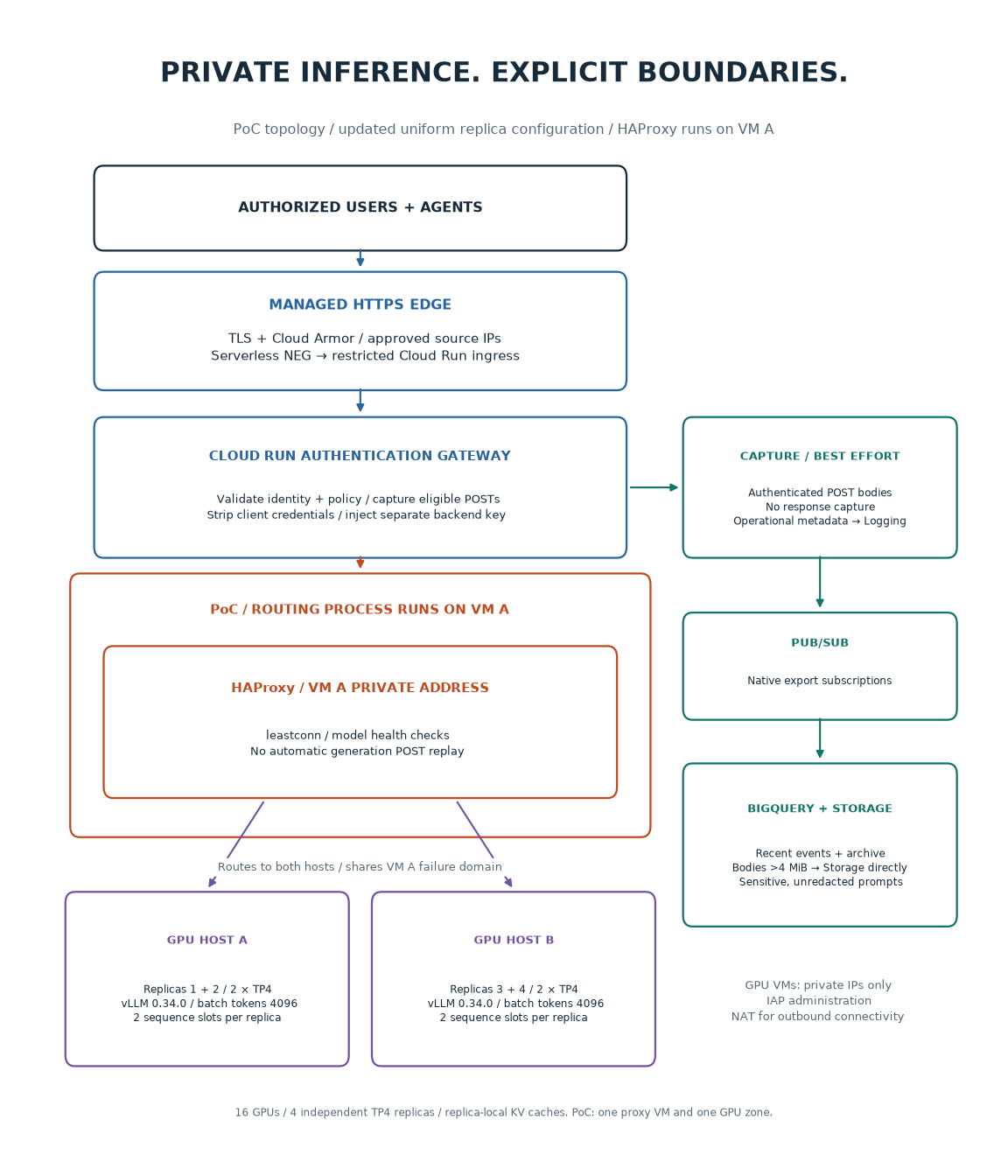
All four replicas use vLLM 0.34.0 with max-num-batched-tokens=4096. Our PoC runs HAProxy on VM A, routing to the replicas on both GPU hosts. The separate routing diagram below shows the recommended resilient design, not the PoC’s deployed topology.
1. HTTPS load balancer, certificate, and Cloud Armor
The global external Application Load Balancer terminates TLS with a managed certificate. Cloud Armor admits approved source IPs and denies other origins. Network admission does not replace authentication.
A serverless network endpoint group (NEG) connects the load balancer to Cloud Run. Cloud Run uses restricted ingress and a disabled default service URL to keep access behind that edge.[2]
2. Cloud Run: identity before inference
A Go gateway authenticates requests, captures eligible payloads, and proxies streaming responses. It does not run inference or filter model behavior. Two credential families cover three consumer groups.
Employees: verify the signature, then authorize the role
Employees present an employee identity token from the company’s identity system. The gateway verifies its JWT signature, algorithm, key identifier, issuer, and time claims, then requires an approved role from the signed payload. A valid employee identity alone does not grant access.
This issuer omits an audience claim. A compatibility exception permits its absence, while a present audience must match. That leaves cross-service replay risk and is limited to this credential family.
Affiliated companies: credentials issued out of band
Affiliated-company users receive a service access token through an authorized out-of-band issuance process. An operator-side CLI signs an ES256 JWT; the gateway holds only verification material, not the signing key. “Offline” here means outside the inference request path, not a public token-issuance endpoint.
The gateway checks signature, issuer, required audience, subject, attribution claims, issuance time, and revocation status. Company and team claims identify the consumer; they do not grant employee roles.
Autonomous agents: a service identity, not a borrowed employee identity
Services and autonomous agents use the same service-token mechanism, with attribution to the registered consumer and responsible team. This avoids borrowing an employee’s interactive identity for unattended work.
| Consumer | Generic credential | Application checks | Network check |
|---|---|---|---|
| Company employee | Employee identity token | Trusted signature, issuer, validity, audience policy, and approved signed role | Approved egress IP |
| Affiliated-company user | Service access token | Trusted signature, exact issuer/audience, required claims, and revocation | Approved egress IP |
| Service or autonomous agent | Service access token | Same verification, with registered consumer attribution | Approved egress IP |
What signature-plus-IP checking does not mean
All three groups must pass both the edge allowlist and application authentication. The observed IP is the public egress address, attributed through trusted load-balancer forwarding information. Tokens are not individually bound to IPs: a stolen credential could be replayed from another approved origin.
Service tokens do not expire automatically. Individual revocation requires adding the token ID to a verification bundle and activating it on the gateway; publishing alone is insufficient, and recovery must preserve effective revocations. Credential selection fails closed: an invalid or duplicated higher-priority credential is rejected rather than falling back to another method.
After authentication, the gateway strips client credentials and injects a separate backend credential for vLLM. The serving revision uses one CPU, 512 MiB RAM, concurrency eight, a 300-second timeout, and a two-instance maximum. The service-level maximum of twenty does not override that tighter revision limit. HTTP admission capacity is separate from model capacity.
3. Direct VPC egress, firewalls, NAT, and administration
Cloud Run uses Direct VPC egress for private-range traffic, without a Serverless VPC Access connector.[8] The gateway is in us-central1 and the GPU hosts are in us-east5-a, so inference requests cross regions.
The documented private transport uses HTTP, protected by routing restrictions, firewall rules, and a separate backend key, not end-to-end TLS or mTLS. Neither GPU VM has an external IP. In the recommended design, the gateway addresses an internal load-balancer VIP, and firewall rules admit inference to the GPU hosts only from the dedicated routing tier. TLS or mTLS on private hops is a separate hardening decision, not a property implied by a private IP.
Cloud NAT supplies outbound connectivity, not inbound access control.[7] Operators administer the hosts through Identity-Aware Proxy (IAP) and authorized guest access, without public SSH addresses.
4. Recommended routing: make HAProxy independent of GPU hosts
The PoC uses HAProxy on VM A. That keeps the deployment small, but VM A’s loss also removes the routing entry point, even if VM B’s model replicas remain healthy. This is an accepted PoC limitation, not high availability. HAProxy checks backend health and uses leastconn across the four replicas; the ideal next step is to separate and replicate that routing responsibility.
Run two dedicated CPU-only HAProxy VMs in different zones, managed by a regional managed instance group, behind a regional internal passthrough Network Load Balancer. The gateway uses the load balancer’s stable private virtual IP, not a GPU host address. Both proxies serve traffic actively and can reach all four model replicas. Google documents this managed load balancer as highly available by design and recommends multi-zone backends.[15]
This separates proxy maintenance and failure recovery from expensive GPU hosts. An instance template pins the proxy image and configuration; staged rollout and connection draining reduce disruption during changes. Avoid treating a floating IP with VRRP alone as a drop-in cloud design: the managed frontend provides the private service address without depending on guest-level address takeover.
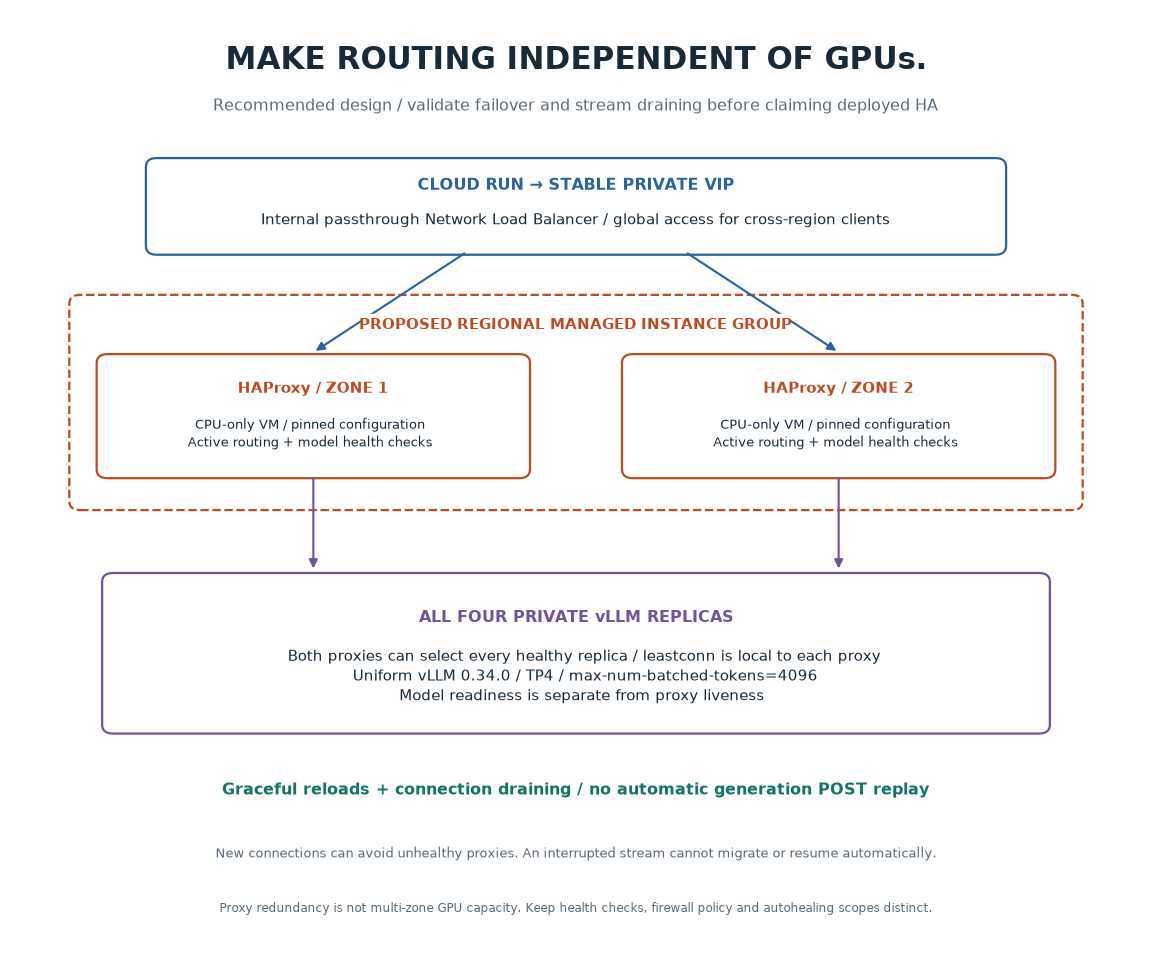
For the existing cross-region gateway placement, enable global access on the internal load balancer and verify VPC routing and firewall rules, or colocate the gateway in the serving region. Global access enables cross-region clients; it does not make this a multi-region backend.[15]
Keep two health decisions separate. The managed load balancer checks whether HAProxy can accept and route traffic; HAProxy checks model readiness before selecting a vLLM endpoint. Expose a narrowly accessible readiness endpoint, and return a controlled unavailable response when no model backend is eligible. Configure instance autohealing to detect a broken proxy process without recreating healthy proxy VMs merely because the shared GPU pool is down. Health-check firewall rules must match the documented GCP probe sources.
HAProxy can retain leastconn, but each proxy sees its own connections, not a globally synchronized GPU queue. Reused gateway connections can also skew the managed load balancer’s connection distribution. Equal weights do not guarantee equal GPU work: prompt length and prefill cost still matter. Monitor both proxy traffic and per-replica queues before increasing admission.
Do not automatically replay generation POSTs. Health checks steer new traffic away from unhealthy backends, but a lost streaming response cannot migrate to another proxy or model replica. Align gateway, proxy, and backend deadlines; use graceful reloads and draining; and make retry decisions explicit at the client, including duplicate-generation risk.[16]
This proposal improves the routing tier, not every failure domain. The GPU allocation remains in one zone; model capacity needs its own multi-zone plan and available reservations before claiming zonal service resilience. Validate the proposal with proxy-process termination, proxy-VM loss, model-readiness failure, and long-stream draining tests before describing it as deployed high availability.
5. Compute Engine G4 hosts and the reservation
The GPU pool uses NVIDIA RTX PRO 6000 Blackwell Server Edition GPUs on GCP. These results concern the RTX hardware’s SM120 compute capability, not H200s; the H100 NVL in my earlier post was a separate Runpod allocation.
The allocation comprises two g4-standard-384 VMs, each with eight GPUs, 384 vCPUs, and 1,440 GiB RAM.[6] Each host runs two independent four-GPU replicas: sixteen GPUs in total, not one model sharded across all sixteen.
The VMs consume a shared reservation owned by another project. Stopping a host can release capacity that may not be available at restart. The reserved shape also requires 32 × 375 GB Local SSDs per host; that provisioned scratch capacity is not a measured inference requirement.
6. Persistent storage and three different caches
Each host has a 200 GB boot disk and a separate 1,024 GB model disk, both Hyperdisk Balanced. Containers mount the checkpoint read-only and keep writable execution caches separate by replica/runtime.
The storage layers serve different purposes:
| Cache or state | Where it lives | What it saves |
|---|---|---|
| Downloaded checkpoint | Persistent model disk, one per host | Re-downloading model artifacts |
| vLLM execution/compilation cache | Separate disk directories | Repeating some runtime preparation |
| Key/value (KV) or prefix cache | A running replica’s accelerator/runtime memory | Recomputing reusable attention history |
Model disks are host-local, and live KV caches are replica-local. Identical checkpoints do not give replicas shared prefix state; leastconn does not preserve conversation affinity.
Reading the model card as a starting point
The selected checkpoint is dealignai/GLM-5.3-Flash-UNCENSORED-NVFP4, pinned at revision 745aac2ff0f10acf961f396df3f9418598aa7327. It derives from zai-org/GLM-5.3-Flash; the publisher calls its persistent weight-editing method CRACK.[3]
The base model has 320B total parameters and approximately 18B active per token. In a mixture-of-experts (MoE) model, that active count describes selected computation, not total weight-storage requirements.[11] The pinned configuration combines linear and sparse attention across 45 language layers, includes vision and multi-token prediction (MTP) components, and sets a 1,048,576-token context ceiling.[4]
| Artifact property | What it means for serving |
|---|---|
| ModelOpt NVFP4 configuration | Selected weights use a compressed four-bit floating-point representation, with other components excluded from quantization.[4] |
| Hybrid attention | Memory planning and kernels must match this architecture; a dense full-attention estimate is not interchangeable.[4] |
| Vision configuration | Multimodal components exist; the recorded text tests do not validate image or video behavior. |
| MTP layer | A draft path is available for speculative decoding; acceptance and speed must be measured on the workload. |
| Configured 1M context | A sequence budget, not a throughput or retrieval-quality guarantee. |
The publisher reports MMLU-logit 85.28% versus 86.16% for the base on 1,026 questions, plus HarmBench refusal rates of zero for off/max reasoning, approximately 4% for high, and 9% for low. I did not reproduce those scores; they do not establish cybersecurity expertise.[3] I served the edited checkpoint without additional fine-tuning.
Comparing the abliteration, not just the model names
Refusal-direction editing identifies activation structure associated with refusal and intervenes on activations or weights. Arditi and colleagues demonstrated the mechanism in the models they studied.[1] Comparing these two artifacts requires looking at their disclosed methods rather than assuming a common algorithm.
| Question | Earlier Qwen/OBLITERATUS artifact | Current GLM/dealignai artifact |
|---|---|---|
| Is the change persistent? | Published metadata records refusal-direction weight editing.[5] | Publisher describes a permanent tensor edit.[3] |
| How are directions extracted? | Five directions using whitened SVD.[5] | Exact extraction procedure is not disclosed in the consulted card.[3] |
| How is collateral change constrained? | Norm preservation, regularization 0.04, and bias projection are recorded.[5] | Publisher describes a conservative edit; no equivalent parameterized surgery record is supplied.[3] |
| Is refinement documented? | Three re-probed passes, activation winsorization, and selected layers are recorded.[5] | No comparable pass count or layer-selection configuration is disclosed.[3] |
| What else is attributed? | Its card describes SVD/LEACE blending across release stages.[12] | Publisher says the MTP head is edited too.[3] |
| My deployment’s role? | Served an already modified checkpoint. | Served an already modified checkpoint. |
SVD extracts directions from activation data; whitening adjusts their covariance. LEACE provides linear concept erasure. The GLM card does not disclose enough detail to identify CRACK with either method or infer expert-by-expert editing from the MoE architecture.
NVFP4 is quantization, not abliteration. The separate W4A16 and NVFP4 trials compared numerical serving formats: packed INT4 expert weights with groups of 32 versus floating-point weights with groups of 16. Plain decode medians were roughly 110–112 tokens/s on the tested TP4/runtime path. NVFP4 with one-token MTP was faster in some samples, but near-1M cells had only one request per model. That does not establish a general format winner or a refusal-removal advantage.
The vLLM contract: the parts that must agree
Each replica uses tensor parallelism across four GPUs (TP4). The updated pool uses one runtime configuration across both hosts:
| Replicas | GPU allocation | Installed vLLM | Maximum batched tokens | Maximum sequences |
|---|---|---|---|---|
| 1 and 2, host A | One independent four-GPU group each | 0.34.0 | 4,096 | 2 each |
| 3 and 4, host B | One independent four-GPU group each | 0.34.0 | 4,096 | 2 each |
Images are pinned by digest, and every replica should pass the same startup, authentication, completion, and tool-call acceptance checks after an update. Here, 4,096 is the scheduler’s maximum batched-token budget, not 4,096 simultaneous requests, a context-window limit, or a throughput measurement. The per-replica sequence cap remains two.
Common settings include BF16 computation, NVFP4 weights, fp8_ds_mla KV storage, gpu_memory_utilization=0.70, and one-token MTP. The historical trial selected a Marlin kernel path and recorded hardware-specific warnings; four-bit storage alone does not establish native four-bit arithmetic.
The glm47 tool parser, glm45 reasoning parser, native chat template, and automatic tool choice must agree on the generated format.[9] Defaults are reasoning_effort=low and clear_thinking=true. The template explicitly handles low and high; other values fall through to its deepest mode. Clearing prior thinking does not disable new reasoning.[14]
The low-effort default also differs from the publisher’s zero-refusal evaluation modes, so those scores should not be assigned to this endpoint.[3]
What changed how I think about capacity
More GPUs did not make an unsupported kernel shape work
Historical trials with tensor parallelism across eight GPUs (TP8) loaded the weights but failed during sparse-attention warmup on the tested SM120 stack. TP4 passed startup and bounded functional checks.[13] This illustrates why an architecture-compatible runtime matters more than GPU count alone; it is not a new comparison on the updated runtime.
Long input support is not long-context reliability
Sequential synthetic retrieval tests processed more than one million input tokens. One early-marker MTP request used 1,044,523 input tokens and 26 output tokens in 162.2 seconds. The same history includes a failed 512K retrieval attempt and transient allocator OOM warnings during otherwise successful requests.[13]
These results demonstrate specific executions, not representative retrieval quality or safe concurrent million-token workloads. KV-pool startup estimates and the 0.70 memory-budget setting are not guarantees of usable capacity or peak-memory limits.
MTP helps a different part of the request than prefill
Prefill processes input; decode generates the continuation. MTP proposes tokens for the main model to verify, potentially accelerating decode. In the matched NVFP4 samples, decode improved while near-1M time to first token (TTFT) increased. Those long rows had one observation each.[13] Faster output generation did not remove the cost of reading a large fresh prompt.
Two sequence slots are not two independent prefill engines
An earlier campaign compared two fresh long requests sharing one TP4 replica against one request per independent replica. At the 524,288-token target, pair-completion medians were 129.166 seconds together and 67.318 seconds split, with 1,024 output tokens per request and three measured rounds per cell.
The split case also used twice the GPU partitions. It illustrates prefill contention, not a runtime-version win or a full-pool throughput result. Four replicas provide eight configured sequence slots; simultaneous near-1M use across all eight was not validated.
Prefix caching changes the experiment
That campaign used fresh prefixes, while earlier observations included substantial prefix reuse. Their latencies are not directly comparable. Conversation affinity might improve cache locality, but concentrating long requests on one replica could increase queueing; the pool does not implement affinity.
Prompt capture is another sensitive system
The gateway captures authenticated POST bodies and masked incoming headers before backend rewriting, but not model responses. Prompt bodies are not redacted, so the capture system must be treated as sensitive data infrastructure. Cloud Logging receives operational metadata rather than these bodies.
Pub/Sub delivers events to native BigQuery and Cloud Storage export subscriptions, without an intermediate Dataflow job.[10] BigQuery provides a partitioned events table and deduplicating request view. Bodies larger than 4 MiB are uploaded directly to Cloud Storage; events retain the object generation, size, and hash needed to identify them.
Retention differs by layer: seven days in the Pub/Sub topic, thirty days for BigQuery partitions, and object lifecycle eligibility for Archive after thirty days and deletion after 365. Lifecycle actions need not occur at the exact eligibility time.
Capture is availability-first: publication or upload failures do not reject inference. A successful model response can therefore lack a durable capture record. The documented IAM design separates publication, export, token issuance, backend credentials, and archive reading.
Observability: name the layer before quoting the latency
Different layers answer different operational questions:
| Layer | Useful signals | What they do not prove |
|---|---|---|
| Load balancer / Armor | Edge denials, request outcomes, backend routing | Which model queue delayed a request |
| Cloud Run | Request counts, duration distributions, instance admission, errors | Prompt token count, model TTFT, or GPU saturation |
| Gateway audit | Accepted credential attribution, route, completion status and duration | The human operating a credential; complete payload capture |
| vLLM replica | Running/waiting requests, KV pressure, preemptions, prefix hits, token histograms | Per-request identity from independent aggregate histograms |
| GPU / host | Utilization, VRAM, RAM, CPU | Root cause from one busy-GPU snapshot |
| Capture exports | Backlog, publication failures, dead letters | Complete forensic coverage just because exports are configured |
Private vLLM diagnostics rely on network and host-access boundaries; the model API key does not secure every diagnostics route.
Verify that alert policies have working notification destinations and that GPU and queue metrics are collected persistently. An enabled alert rule does not by itself establish paging, and a one-time diagnostic read does not establish monitoring coverage.
Before raising gateway admission, correlate request latency with model queues and GPU activity. Gateway duration includes more than generation, HTTP bytes are not tokens, and completed-request samples omit work still waiting. More HTTP concurrency can lengthen the inference queue without increasing throughput.
What I would improve next
The next priorities are validating the proposed routing tier under failure, representative red-team workload tests on the uniform runtime, shorter credential lifetimes, and explicit telemetry and audit-completeness requirements.
Cost also needs an operating policy. Both GPU hosts run without an automatic stop deadline. Stopping a container does not stop VM, disk, NAT, or edge charges, while stopping a reserved host can make restart capacity uncertain.
Shared serving is more than loading an edited checkpoint. Access boundaries, hardware compatibility, request placement, and evidence retention determine whether the backend is useful in daily work. For teams building a similar service, those are the first decisions I would validate.
Sources
- Arditi et al.: Refusal in Language Models Is Mediated by a Single Direction.
- Google Cloud: Restrict network ingress for Cloud Run.
- dealignai: Pinned GLM-5.3 Flash UNCENSORED NVFP4 model card.
- dealignai: Pinned GLM architecture and quantization configuration.
- OBLITERATUS: Published Qwen3.8-27B abliteration metadata.
- Google Cloud: Accelerator-optimized machines, G4 series.
- Google Cloud: Cloud NAT overview.
- Google Cloud: Direct VPC egress for Cloud Run.
- vLLM: Tool calling, templates and parsers.
- Google Cloud: Pub/Sub subscription types and exports.
- Z.ai: GLM-5.3 Flash base-model card.
- OBLITERATUS: Qwen3.8-27B model card and release-stage methods.
- Emanuel Valente: Historical SM120 deployment and evaluation card.
- dealignai: Pinned native GLM chat template.
- Google Cloud: Internal passthrough Network Load Balancer, availability and global access.
- HAProxy: Retries and redispatches and health checks.