My motivation for learning model serving came from my work at iFood: I saw a potential need to provide abliterated models for red-teaming teams. I wanted to understand the technology before that responsibility became a reality. This was a personal learning experiment, not an iFood production deployment.
The objective was to expose a model through an API and connect it to an agent. I first served OBLITERATUS/Qwen3.8-27B-OBLITERATED, then migrated to medismera/Qwen3.8-27B-OBLITERATED-Mythos-Class-Agentic. Both ran through vLLM on one Runpod H100 NVL.
The experiment taught me to separate three questions: what was changed in the model, how the server uses GPU memory, and what an agent needs to call tools. We will follow that same path here. The results describe my recorded deployment tests through September 17, 2026, not a fresh check of a live endpoint.
What is an abliterated model?
A checkpoint is a saved model artifact: learned numerical parameters (weights), configuration, and associated files needed to load it. An abliterated checkpoint has been modified to reduce behavior associated with refusal. In the downloadable checkpoints discussed here, that modification is already incorporated into the weights. It is not a system prompt saying “ignore your instructions,” and it is not a vLLM setting.[1][2]
The starting intuition comes from work by Arditi and colleagues: across the chat models they studied, a direction in the residual stream was strongly associated with refusal. Removing the component along that direction suppressed refusal; adding it could induce refusal even for harmless requests. They also showed how an inference-time intervention could be implemented as a persistent weight edit.[1]
Activations are the intermediate numerical values computed as a model processes an input. The residual stream is its running vector representation, updated as information passes through transformer layers. A refusal direction is a numerical direction in that space, not a literal policy sentence stored in a particular neuron.
Conceptually, the process is:
- Collect internal activations for prompts associated with refusal and for control prompts.
- Estimate directions that distinguish those activation patterns.
- Reduce those directions through an intervention or weight edit.
- Evaluate both the intended behavioral change and unintended capability loss.
That does not add knowledge, make answers more factual, or guarantee that every refusal disappears. It changes a behavioral mechanism. Claims such as “uncensored” describe an intended effect, not a proof that a model has no remaining bias, safeguards, or limitations.
Two ways to intervene, several ways to refine the edit
The first distinction is where the change happens. Runtime ablation removes a component from activations while the model runs; persistent weight editing changes the checkpoint itself. The second is how much structure is targeted: one refusal-associated direction or a multidimensional subspace. Refinements such as norm preservation, layer selection, and iterative passes aim to limit damage or address behavior left after the first edit.[1][2]
These choices can be combined; they are not mutually exclusive model categories. Fine-tuning is a different way to change behavior, and quantization is a separate choice about numerical precision. Neither “fine-tuned” nor “4-bit” identifies a directional abliteration method.
OBLITERATUS: from research to an editing pipeline
OBLITERATUS, the toolkit named by my original checkpoint’s publisher, implements a pipeline: load a model, probe activations, extract directions, apply an intervention, evaluate the result, and save the artifact.[14]
It builds on a broader research lineage, including Arditi’s refusal-direction work, activation steering by Turner and colleagues and Rimsky and colleagues, and later multidirectional and norm-preserving methods. It would be inaccurate to attribute all contemporary abliteration to Pliny or OBLITERATUS. The project brings earlier work together with additional implementations and experimental techniques.[1][14]
I am a big fan of Pliny the Prompter and regularly follow his posts. For anyone interested in model behavior, jailbreaks, and AI red teaming, I think @elder_plinius on X is well worth following.[16]
To understand the techniques, it helps to follow the editing pipeline rather than read a list of preset names:
- Find the signal. Contrastive prompts generate activation examples. Mean differences or singular value decomposition (SVD) estimate refusal-associated directions. Multidirectional SVD captures a subspace rather than one vector; whitening adjusts covariance structure so naturally high-variance components do not dominate extraction.
- Apply the intervention. Projection removes components along those directions. Weight orthogonalization makes the edit persistent; projecting relevant biases addresses another possible contribution. Norm preservation, regularization, and separate attention/MLP strengths attempt to reduce collateral changes.
- Refine the result. Layer selection chooses where to intervene. Iterative refinement re-probes after an edit, because the remaining signal can differ from the original. Winsorization limits extreme activation values that could distort extraction.
- Evaluate the trade-off. Reduced refusal must be checked alongside capability, coherence, and benign over-refusal, meaning refusal of requests that should be answered. The toolkit’s workflow guide recommends a pristine baseline and held-out prompts not used to fit the edit.[14][15]
Preserving weight norms or removing a measured direction does not guarantee preserved reasoning or universally reduced refusal. Those are behavioral outcomes to test.
Which of those techniques did my checkpoint use?
I downloaded an already edited checkpoint; I did not run the abliteration pipeline myself. Its metadata identifies persistent, multidirectional refusal-direction editing. The Mythos derivative carries the upstream metadata and adds agent-oriented configuration and template changes.[3][4]
| Technique recorded in the metadata | Configuration | Intended benefit |
|---|---|---|
| Multidirectional, whitened SVD | Five directions; whitening enabled | Capture several components while reducing domination by unrelated activation variance. |
| Norm-preserving, regularized projection | Norm preservation enabled; regularization 0.04; bias projection enabled | Limit changes to weight scale while also editing relevant biases. |
| Iterative refinement | Three passes; re-probing enabled | Address refusal-associated signals remaining after earlier edits. |
| Activation winsorization | Enabled | Reduce outlier influence during extraction. |
| Layer selection | knee_cosmic; minimum layer fraction 0.4 | Select intervention layers instead of assuming all layers are equally relevant. |
The metadata reports 1,007 refusal-associated prompts and 1,007 control prompts. The model card describes a broader V1 → V2 → V3 process that also blends SVD-edited and LEACE-edited weights. LEACE is a linear concept-erasure approach; the publisher’s rationale is that blending edits with different trade-offs can balance refusal reduction and capability preservation. The metadata is not a complete record of every intermediate surgery, and I did not reproduce that comparison.[3]
What about the techniques it did not use?
OBLITERATUS also documents several alternatives. Relating them to this artifact makes their purpose clearer:[14][15]
| Alternative | What it adds | Status for my checkpoint |
|---|---|---|
| KL-divergence co-optimization | Constrains changes to token distributions relative to a pristine model. | Disabled. A reported KL measurement does not mean KL was used to optimize the edit. |
| Chain-of-thought (CoT) protection | Constrains edits relative to reasoning-associated directions. | Disabled; no protected CoT layers listed. |
| Low-rank adaptation (LoRA) | Packages an intervention as an adapter that can remain separate from base weights. | Disabled; no adapters saved. I served full modified weights. |
| Fractional layer interpolation and concept shielding | Offer finer intervention placement or constraints intended to protect other representations. | Not enabled in the metadata. |
| Expert-granular editing | Targets individual expert networks in mixture-of-experts (MoE) models, which route tokens to selected experts. | Not a natural fit: this is a dense model, without routed expert networks. |
For the disabled options, the publisher does not provide a checkpoint-specific reason. I cannot claim that they were unnecessary, too expensive, or inferior. The dense-versus-MoE distinction explains the architectural mismatch for expert editing, but the other choices would need controlled comparisons.
This overview follows the repository revision cited below, not a claim that every feature existed when the checkpoint was produced. My practical starting point was the finished artifact. The next problem was turning that artifact into a service.
vLLM: the serving layer

vLLM is an open-source inference and serving engine. It loads supported model artifacts, schedules inference, manages GPU memory, and can expose an OpenAI-compatible HTTP API. It does not perform the abliteration in this deployment; it serves weights that were already modified.[5]
It is useful both for offline batch generation and for online services such as chat applications, retrieval-augmented generation, and agent backends. An early documented example is its use behind LMSYS’s Vicuna and Chatbot Arena serving stack.[5]
Here, serving means keeping a model loaded and accepting inference requests over an API. For my experiment, the important interfaces were /v1/models and /v1/chat/completions. An OpenAI-compatible API let the client change its base URL and model name without requiring a new transport integration. However, API compatibility does not mean that every checkpoint automatically supports every feature of that API.
I used a custom image based on vllm/vllm-openai:v0.27.1. Pinning the engine mattered because the artifact declares Qwen3_5ForConditionalGeneration, despite the Qwen3.8 name. Compatibility depends on the actual architecture, tokenizer, and runtime, not just the checkpoint’s title.
What are recipes, and why do they matter?
A serving recipe is a model-and-hardware-specific configuration: runtime version, launch command, precision or quantization, parallelism, context limit, memory settings, and sometimes reasoning and tool-call parsers. vLLM publishes recipes to make these combinations easier to reproduce.[6]
Recipes matter because “the model fits” is only the beginning. A different GPU, engine version, quantization branch, or chat template can change whether the same command works. A recipe is a starting point with assumptions, not a portable guarantee.
My deployment effectively became a small recipe of its own:
| Setting | Tested configuration |
|---|---|
| Runtime | vLLM 0.27.1 |
| GPU | One H100 NVL, 94 GB class |
| Weight precision | BF16; no weight quantization |
| Maximum model length | 262,144 tokens |
| Maximum active sequences | 1 |
| GPU memory utilization | 0.94 |
| CPU offload | Not enabled |
| Thinking | Disabled for the recorded integration tests |
| Automatic tool-call parser | qwen3_xml |
| Mythos chat template | Native checkpoint template |
The template and parser settings will matter in the tool-calling section. First, the infrastructure has to fit the model and its runtime state.
Runpod: the infrastructure layer

Runpod provides access to GPU compute. I chose a dedicated Pod: a container environment with an allocated GPU, configurable storage, and exposed network ports. This gave me a direct place to run the vLLM API continuously while learning the stack.[7]
I did not use Runpod Serverless. That would have introduced a different worker lifecycle and cold-start/cache design. It could be useful for another workload, but the dedicated Pod was the simpler starting point for this experiment.
The container exposed port 8000 through Runpod’s HTTP proxy. Clients used HTTPS, and vLLM enforced bearer-token authentication. The API key came from Runpod Secrets at startup rather than being baked into the image. This is a public endpoint with authentication, not a private network service.[8]
Why an H100 NVL?
The originally considered H100 PCIe capacity was unavailable, so I deployed one H100 NVL in Community Cloud. Its 94 GB memory class gave more headroom than an 80 GB option while retaining native BF16 support. NVIDIA’s H100 specifications distinguish the H100 NVL from the H100 SXM.[9]
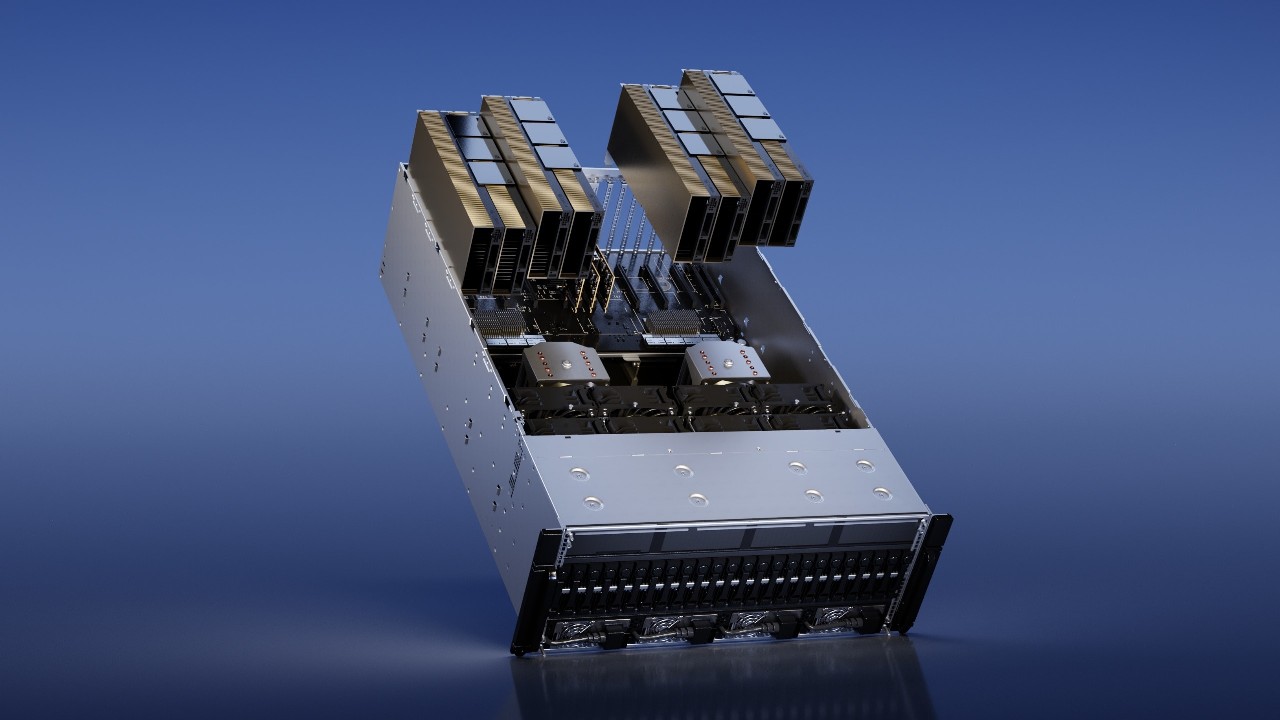
BF16 (bfloat16) stores each weight value in two bytes. I use GiB for calculated memory sizes: one GiB is 2³⁰ bytes, unlike the decimal GB used in many product labels. Safetensors is the weight-file format; its index declares 55,562,855,904 bytes: approximately 51.75 GiB of weights.[10] A 48 GB card cannot hold that complete BF16 artifact, even before runtime overhead. Quantized variants are a different sizing exercise; I did not deploy them here.
The recorded rental rate was US$2.59 per GPU-hour. That is a historical rate for this experiment, not a current quote. My practical cost control was to stop the Pod when I did not need the endpoint, while retaining its model cache on disk.
“How much space does the model occupy?” has three answers
The downloaded checkpoint occupies disk space; inference also needs GPU memory (VRAM). I used three resources:
| Resource | My configuration | What it holds |
|---|---|---|
| GPU VRAM | One H100 NVL | Loaded weights, live attention state, activations, and CUDA/vLLM allocations |
| Pod Volume | 100 GB at /workspace | Hugging Face model files and reusable runtime/JIT disk caches |
| Container disk | 50 GB ephemeral disk | Container-local files; not the durable model-cache location |
/workspace/hf held downloaded artifacts. /workspace/vllm held reusable runtime cache files. Neither directory was a saved copy of the live GPU KV cache.
A Pod Volume survives stop/restart, but is deleted when the Pod is terminated. A Network Volume is a separate storage choice for data that must survive replacement of the Pod.[7][11]
This distinction also mattered during migration: two complete BF16 weight caches would exceed the 100 GB volume before other files. I recorded the rollback configuration, removed the old model cache through a one-time migration control, and cleared that control after startup. Changing MODEL_ID was therefore also a storage operation, not just a string replacement.
KV cache: why weights are only part of the budget
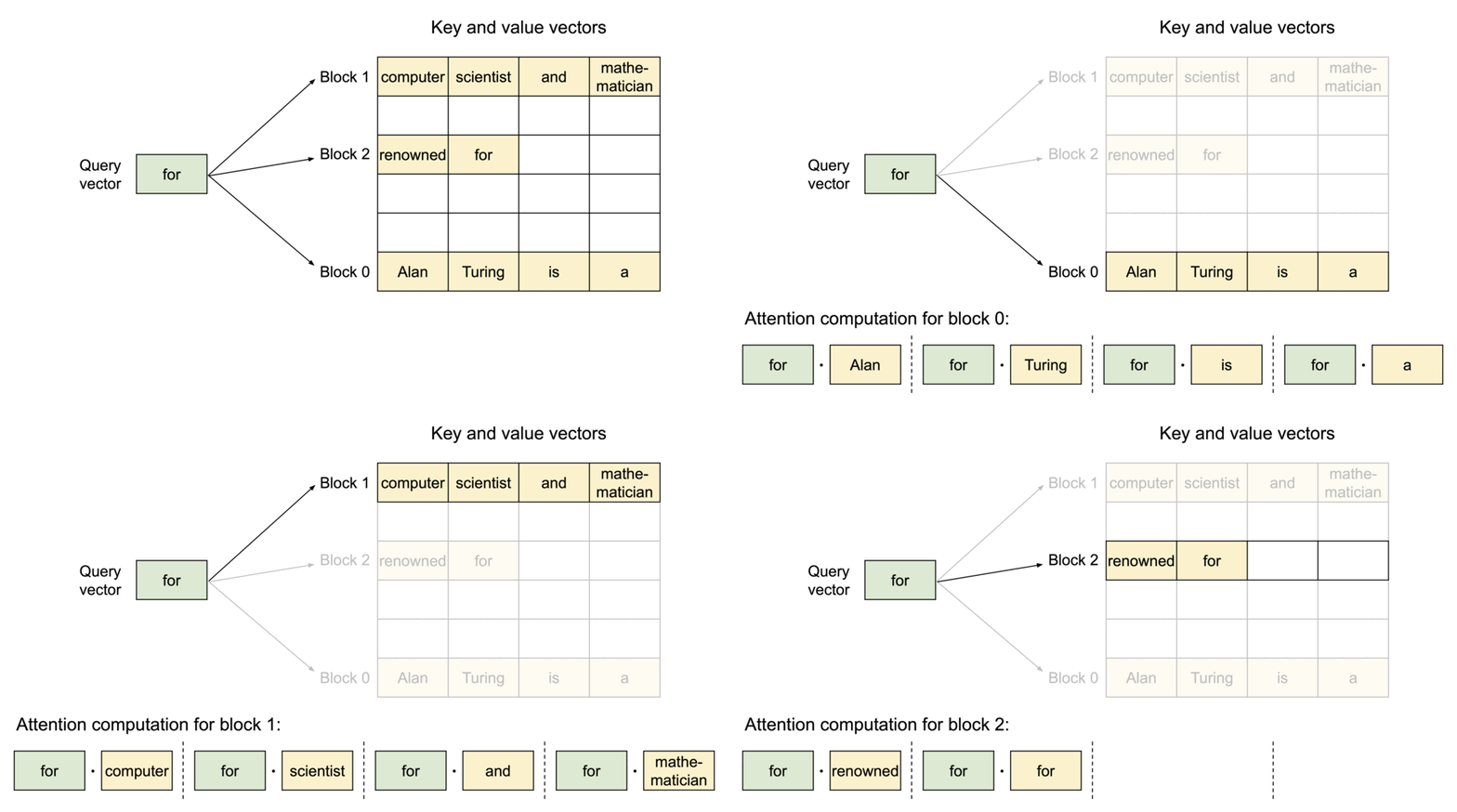
A token is a unit of text processed by the model, often a word fragment. In autoregressive generation, the model produces the next token using the preceding context. Full-attention layers compare a current query (Q) with earlier keys (K) and combine their values (V); they reuse those earlier key and value tensors as generation continues. Keeping those tensors avoids recomputing the same attention history for every new token. That state is the KV cache.[5]
The weights are largely fixed for a loaded model. Attention state depends on the workload: context length, precision, architecture, and active sequences. More context can require more memory even though no additional model parameters have been loaded.
vLLM’s PagedAttention manages full-attention KV storage in blocks, using an idea analogous to virtual-memory paging. Logical sequence blocks can map to noncontiguous physical blocks, reducing fragmentation and over-reservation. It improves memory management; it does not make the cache free.[5]
The calculation for this particular model
The actual configuration describes a hybrid stack: 64 layers, with full attention every fourth layer. That means 16 full-attention layers and 48 linear-attention layers. The full-attention portion uses four KV heads with a head dimension of 256.[10]
The four KV heads share stored attention history across the query heads; using the query-head count here would overestimate this cache. For one sequence with BF16 K and V, its full-attention lower bound is:
KV bytes per token
  = full-attention layers × K/V × KV heads × head dimension × bytes
  = 16 × 2 × 4 × 256 × 2
  = 65,536 bytes
  = 64 KiB per token
| Tokens in one sequence | Full-attention KV lower bound | Weights + that KV component |
|---|---|---|
| 16,384 | 1 GiB | About 52.75 GiB |
| 65,536 | 4 GiB | About 55.75 GiB |
| 131,072 | 8 GiB | About 59.75 GiB |
| 262,144 | 16 GiB | About 67.75 GiB |
These are calculated planning values, not measured peak VRAM. They omit the 48 linear-attention layers’ recurrent/convolution state, activations, CUDA graphs, workspaces, and allocator overhead. Applying the full-attention formula to all 64 layers would misrepresent this architecture.
I set GPU_MEMORY_UTILIZATION=0.94 to leave some memory outside vLLM’s budget. It is not a utilization target saying the GPU should be busy 94% of the time. It is a memory-budget setting, and the usable byte count must come from the device/runtime rather than blindly treating a marketed GB value as GiB.
I also set MAX_NUM_SEQS=1. This deliberately favors one long-context sequence over concurrent throughput. Raising concurrency changes memory requirements and needs its own load test.
Here, 262,144 is the total sequence ceiling, covering the input and generated continuation. It is not an allowance for that many input tokens plus an unlimited answer. Startup and short-request tests are covered below; they are not a full-window benchmark.
The deployed architecture
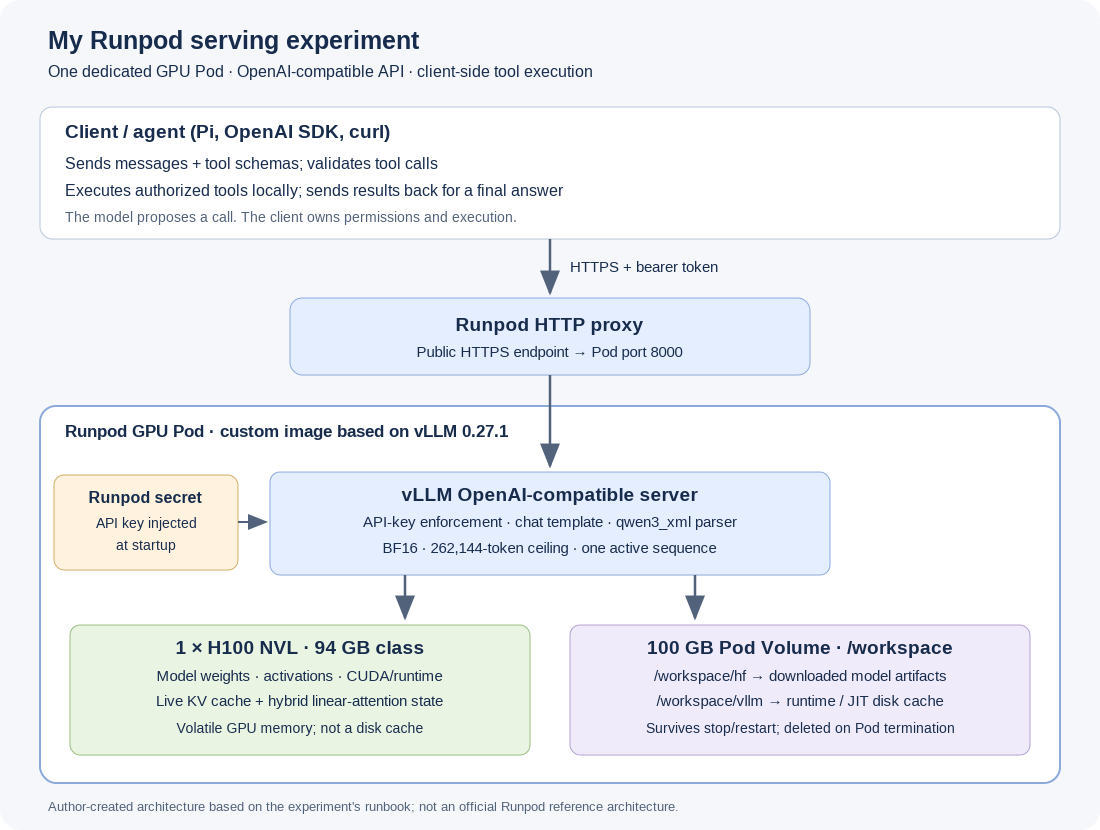
This is my deployment diagram, not an official Runpod reference architecture. The product images elsewhere in this post come from their respective publishers.
The most important boundary is between the model server and the agent. vLLM generates the proposed tool call; the client decides whether to execute it and sends back the result. The H100 does not acquire filesystem or shell access merely because the response contains a function name.
That boundary is especially important with an abliterated model. Authentication protects access to inference; it does not provide per-tool authorization, sandboxing, rate limits, or human approval for consequential actions. Those remain responsibilities of the surrounding application.
My launcher also enabled --trust-remote-code. That is a separate supply-chain trust decision: model-provided code may execute in the serving environment when required by the loader. An authenticated endpoint does not mitigate that risk. For a hardened deployment, I would review that dependency and pin reviewed artifact revisions rather than treating a public model repository as inherently trusted.
Tool calling: where the first integration broke
An agent combines model responses with executable tools. I used Pi as the agent client: it supplied tool definitions, interpreted calls, and returned their results to the model. Ordinary text generation worked before this integration did. The first error was:
"auto" tool choice requires --enable-auto-tool-choice and --tool-call-parser to be set
Pi requested tool_choice: "auto", but vLLM had not been configured to accept and parse automatic tool calls. That explained the immediate rejection, but enabling two flags was not the entire fix.[12]
There are three contracts to align:
- The client sends tools and their argument schemas through the API.
- The chat template serializes those definitions, previous calls, and tool results into the model’s conversation format.
- The tool-call parser translates generated markers and arguments back into the API’s
tool_callsstructure.
Problem one: the original checkpoint’s template
The original OBLITERATUS package shipped a 506-byte, text-only template. It handled system, user, and assistant, but did not serialize tool definitions, tool_calls, or tool results. An API can accept a tools field without the model ever receiving a useful representation of it.
For that checkpoint, I vendored the base Qwen model’s tool-aware chat_template.jinja from a pinned revision. Only the template was copied, not the base model’s weights, vocabulary, or configuration.[13]
The integration paired it with:
--enable-auto-tool-choice
--tool-call-parser qwen3_xml
--chat-template /usr/local/share/qwen3.8-tool-use.jinja
The model’s weights remained abliterated. The change repaired conversation serialization rather than undoing the weight edit or training new tool-use capability.
I then exercised model discovery, an automatic get_weather call, JSON argument parsing, and a final answer after a synthetic tool result. That verified the protocol round trip. It did not verify a real weather service or grant the model permission to run shell commands.
Problem two: the Mythos migration’s parser
The Mythos-Class Agentic package includes a tool-aware native template, so I changed the launcher to preserve it rather than overwrite it with the legacy template. Its model card recommended vLLM’s hermes parser.[4]
In my pinned vLLM 0.27.1/Pi combination, that parser produced an empty assistant response. Replacing it with qwen3_xml, while keeping the native template, enabled an automatic read call, consumption of the result, and the expected final answer in a disposable workspace.
The working diagnosis was a parser/serialization mismatch, not a GPU-capacity failure. The template emitted Qwen XML tool-call structure; the parser needed to understand it. This result applies to my tested combination, not every use of hermes.
The core configuration after migration was:
MODEL_ID=medismera/Qwen3.8-27B-OBLITERATED-Mythos-Class-Agentic
TOOL_CALLING_ENABLED=true
CHAT_TEMPLATE_MODE=native
TOOL_CALL_PARSER=qwen3_xml
MAX_MODEL_LEN=262144
MAX_NUM_SEQS=1
GPU_MEMORY_UTILIZATION=0.94
ENABLE_THINKING=false
These are environment settings consumed by my custom launcher, not a universal set of vLLM environment variables. The launcher translates them into vllm serve flags and receives the API key separately from Runpod Secrets.
What I actually verified
The deployment evolved from shorter context settings to a 256K single-sequence configuration. The Mythos migration started at 128K, passed the corrected Pi integration, and then returned to the native 256K ceiling.
| Check | Recorded result | What I take from it |
|---|---|---|
| vLLM startup | Application startup complete | The engine and API initialized on the allocated GPU. |
| Unauthenticated model discovery | HTTP 401 | Bearer authentication remained enforced on that route. |
| Authenticated model discovery | Advertised 262,144 tokens | The running engine accepted the configured context ceiling. |
| Original checkpoint tool smoke | Automatic weather call, JSON arguments, synthetic result, final answer | That checkpoint’s repaired API/tool serialization worked for the test. |
| Mythos with Pi | Automatic read, tool result, expected final answer | A client-side tool round trip worked in a disposable workspace. |
I have not established near-256K prefill performance, long-context answer quality, sustained throughput, concurrent capacity, multimodal behavior, or reliable arbitrary filesystem/shell automation. A passing single-tool test is not a general agent benchmark.
What I would take into the next deployment
The central lesson is that a working agent endpoint requires compatible layers: edited weights, correct conversation serialization, a matching output parser, sufficient runtime memory, and controlled client-side execution. Loading the model proves only part of that chain.
My next step would be to benchmark the workload I actually care about: realistic context sizes, time to first token, tokens per second, GPU-memory high-water marks, and repeated tool-use tasks in an isolated environment. Only then would I change concurrency, precision, or hardware.
For now, I have recorded a working authenticated BF16 deployment and bounded tool-call round trips. If AI Security at iFood takes responsibility for providing this kind of serving, I will share the additional engineering and lessons in future posts.
References
- Arditi et al. Refusal in Language Models Is Mediated by a Single Direction, NeurIPS 2024. The research basis for directional ablation and weight orthogonalization.
- Maxime Labonne. Uncensor any LLM with abliteration. A practical explanation of activation interventions and persistent edits.
- OBLITERATUS. Model card and abliteration metadata. Method and capability claims are the publisher’s, not independently reproduced results.
- medismera. Qwen3.8-27B-OBLITERATED-Mythos-Class-Agentic. Package lineage, native-template changes, and the publisher’s deployment recommendations.
- vLLM team. vLLM: Easy, Fast, and Cheap LLM Serving with PagedAttention. Official explanation and animation of KV-cache paging, online/offline inference, and historical serving examples.
- vLLM. Interactive serving recipes and recipe documentation. Model/hardware-specific configuration guidance.
- Runpod. Pods overview. Dedicated compute, containers, and operational model.
- Runpod. Expose ports. HTTP proxy and networking configuration.
- NVIDIA. H100 Tensor Core GPU. H100 NVL specifications and official hardware illustration.
- medismera. Model configuration and safetensors index. Sources for the architecture and declared weight-byte calculation.
- Runpod. Storage types. Container disk, Pod Volume, and Network Volume lifecycle.
- vLLM. Tool calling documentation. Automatic tool choice, templates, and model-specific parsers. My experiment used version 0.27.1; current documentation can differ.
- Qwen. Base-model chat template at the revision used in the original integration.
- elder-plinius. OBLITERATUS source repository, README at the revision consulted. Toolkit workflow and documented editing options; not evidence that I ran that pipeline myself.
- OBLITERATUS. Choose a workflow and understand its results. Intervention selection, reversibility, held-out evaluation, and interpretation limits.
- Pliny the Prompter. GitHub profile and X profile. The X handle was cross-checked against the public GitHub profile’s
twitter_usernamefield.
Deployment-specific observations are from my llms-ablt/runpod runbook, launcher, smoke test, migration assessment, and changelog. Publisher claims above are explicitly separated from my own recorded tests. Official image sources and local evidence provenance are listed in the accompanying asset/source notes.